Scottish institute develops new electronic paper display
By Marcelo Duran
Associate Editor
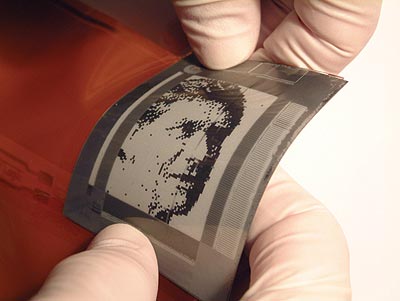
Electronic paper is one step closer to becoming a reality, thanks to a team of Scottish scientists.
Researchers at the University of Paisley in Scotland developed a prototype plastic electronic display screen in partnership with DuPoint-Teijin Films and Plastic Logic.
Professor Frank Placido, director of the Thin Film Centre at the University of Paisley, said the production of a pixilated flexible display required the development and manufacture of the switching electronics - an active-matrix backplane - on a polymer, or organic, backing.
A readable electronic display equivalent in resolution to a high-quality magazine would be an attractive option for newspapers, experts say.
Photo: University of Paisley
“This is not a simple task, because conventional silicon-based electronics require processing temperatures that are too high for polymer sheets,” he said. “Hence, existing commercial displays are based on fragile glass substrates.”
Paisley’s prototype, by contrast, sports plastic transistors placed on a polymer surface.
Laminated
It’s then laminated to a display technology developed by E-Ink Corp. to produce “a working display,” Placido said.
The Polymer Vision display, introduced last year by E-Ink and Royal Philips, is an ultra-thin, large-area scrollable device that’s capable of letting consumers comfortably read text-intensive documents, according to the company (see Newspapers & Technology, March 2004).
posted by Liliana at 2:49 PM


0 Comments:
Post a Comment
<< Home